Why couldn't we spend a £40 million capital loan on current council-owned buildings across the city instead of just one? Here are two ideas for what we could do with them if we did, for debate:
Make every space a working web hub
The advantage of having so many buildings across the city in an era of broadband should be obvious. Forget the idea of single-use, purpose-built offices and make it possible for every council worker and councillor to book and log in to a computer in any council building. They could also use the spaces for meeting local people and partners or to support day service users and others with care needs. Charge organisations or projects that can afford it, otherwise allow free use - prioritising paid hiring and asking groups who are meeting for free to be flexible with the space they have. Make wifi available even if computers aren't possible. Put in more terminals if they can be supported - free for library uses and the unemployed, perhaps with subscriptions for those who want to spend longer on them. Train staff to train more volunteers to encourage even more people to get online and provide the often intensive one-to-one support this initially requires, or to run local informative web services the rest of the time. This would make a massive contribution to digital inclusion in the city, bringing cost-saving benefits to council and other government services. It could bring community members out of their houses and give them valuable experience and skills and the people who become really good at it can end up trainers, consultants or entrepreneurs.
Broadband also provides a wealth of further business possibilities: low-cost studios for local photographers or rooms with specialised hardware and software for organisations that occasionally need them but can't afford a full suite of their own, or for education. Secure storage facilities and meeting rooms could again be rented to organisations or provided to council workers to enable work across the city without always using cars. Huge numbers of us could then work within walking distance rather than having to commute, which would have a positive effect on rush hour and make Stoke an even more pleasant city to live in. If we need to go across the city for a meeting, then we can stay over there and work rather than having to dart back to a fixed office. A lot of these facilities will require funding as well, but this can be developed gradually with creative, small projects including, of course, energy generating projects.
Social enterprise coffee shops should be encouraged everywhere to provide grazing for the emerging generation of people who want to work virtually with wifi as well as older people who want to stay warm and get out to meet people. These shouldn't undercut local markets but should provide test-trading spaces that allow people to start out in small business, as has been done within some of the markets, and learn skills, as seen very successfully at the Burslem School of Art cafe. Again, as long as the basic infrastructure is provided, barriers to entry can be reduced and as people become more confident they can move on and encourage more people to follow in their footsteps.
Broaden business planning and grow confidence
The current CAT process puts enormous pressure on small community groups and committees to find all the answers by themselves. Just as with Tunstall pool, the likely answer is that there is no wealthy flock of pool-goers queuing up to maintain an expensive Victorian pool within the current recession. The pool was enormously popular but relied on subsidies and school visits. That isn't to say that the same group couldn't have been an effective steering group, growing local involvement and finding new income streams for the pool. The group's biggest problem was that as soon as the pool closed, its users dispersed and the life was drained from a passionate campaign and loyal groups.
You could have many groups working for different generations or different parts of a building and its gardens, spreading the workload and risk and drawing on wider population groups. The best example of this working is Burslem Park, where years of volunteer effort developed into a strong, viable Heritage Lottery funded project with equal input from the council and other partners.
The groups of volunteers who are attempting to take on big, risky community centres and run them sustainably deserve a confidence boost and a lot more love and respect. Councillors and officers should be shouting about their efforts from every rooftop and linking them up with every source of help they can think of. They're doing it for the benefit of others in their community, people who in many cases can't afford to go anywhere else. Many are themselves retired and would prefer to be users than building managers. Many more people will not - can not - get involved because they haven't got time or energy for what looks all too often like an impossible challenge. A few of these groups make it to become strong cooperatives or development organisations. Others dwindle and struggle on.
To hand over the entire risk of community buildings is unfair and, potentially, undemocratic unless you can get definite assurances that they will make it available for the whole community; borne more out of desperation to save money than any strategic thinking. Kneejerk hurtling towards closure leads to expensive, depressing, confidence-sapping monoliths sitting in some of the most high-profile parts of the city. Instead, basic coordination, facilitation and maintenance of buildings and land could be provided by the council while they are in their ownership - not forgetting that this cost and responsibility could be handed over if they are sold to viable organisations that have had the time and space to develop properly.
Wednesday, January 09, 2013


Wednesday, January 02, 2013
This Land is Mine and Psycho - a comparison
Today I watched the 1943 movie 'This Land is Mine'. Amazed that the internet mice haven't written more about the links between this film and Psycho, I thought I should oblige. I've tried to avoid spoilers here as I do recommend both films if you're not already familiar with them.
This Land is Mine is a fairly explicit propaganda film made once America was involved in the second world war. It is set "Somewhere in Europe" and that somewhere is probably France. It starts out as a lightly comical look at life under occupation but later becomes a courtroom drama. The transformation of the main character is from cowardly schoolteacher and mother's boy to upstanding pacifist martyr, speaking out for his nation and finding a voice to express himself to the woman he loves. It has some great speeches, wittily shows how resistance took place in nations that ceased to be free and effectively portrays the easy charm of the Nazi message in starving Europe. It highlights at several points how easily the "middle classes" (which has a wider meaning in America than Britain) in any country can become collaborators. It reaches out to different audiences across the seas by including a reading from the French Bill of the Rights of Man, which has much in common with the USA Declaration of Independence. They were both influenced by Thomas Paine who spent much of his life in France and America winding up his old country by being the really popular writer of Rights of Man. This Land is Mine is a wonderfully stirring affirmation of human rights. It had a record-breaking release at the box office, according to its Wikipedia entry. Its publicity poster, and the title, puts me in mind of Gone with the Wind with the red sky and a strong woman in the forefront (1939).
 |
| Source: Wikipedia: fair use claimed. |
But enough background, onto the intertextuality! As a media studies student I gained more than a passing acquaintance with the symbolism in the 1960 version of Psycho and, although I'm going to have to watch it again to really indulge myself, many crossovers leap out. Most obviously, the mother and son relationship has been completely caricatured in the later film, with Bates picking up the metaphor in the courtroom scene that "we are all two people" and running with it to portray the twisted relationship in which his 'mother' persona kills women out of jealously and possessiveness. In This Land, the killing is not done with a big knife, but by informing. In a couple of cases, this looks far too much like deliberate copying for comic effect, such as a sillouette of Charles Laughton coming down the stairs that looks like the famous view of a Hitchcock cameo and his bursting towards a frosted door with murder in mind has echoes in Janet Leigh's shower scene. I'm sure someone will tell me if I'm reading too much in to this.
In Psycho, Saul Bass's titles and much of Hitchcock's direction includes shadows and the screen being split by lines, suggesting split personalities. In This Land the shadows of windows elegantly show the reality of imprisonment despite apparent freedom. This is underlined by the release of a pigeon that is trapped and given to one of the main characters for food. This theme is again echoed in a monologue by Norman Bates about his creepy taxidermy collection. Is there a tabby cat in Psycho? In This Land, the tabby belongs to the woman Londy loves who comes into his bedroom through the window at night (the cat, that is, not the woman). He brings the cat down to breakfast in the morning and gives it treats in small acts of rebellion against his overbearing mother who, obviously, hates the cat. The camera lingers on a crushed rose given to the character by the emasculating Nazi soldier as he quoted lines from Romeo and Juliet at him and tried to woo him into yet more betrayal. More watching and reading to see if there are any links there.
So the question, my fellow students, is: what were the makers of Psycho trying to do by nicking so many of the elements of a film about Nazi-occupied Europe? Psycho is based on a novel written the previous year, a fairly straightforward tale of an American gone mad and I think most of the crossovers have been added in Hollywood processes. How about personal links between film-makers? Hitchcock and Laughton were both British and contemporaries, born in the same year and with a similar career path. They never worked together again, as far as the listings tell, following Jamaica Inn, which was Hitchock's last UK-based film before they both went to Hollywood and in which, according to Wikipedia again, there were creative tensions between the two. Could the similarities in character portrayal, in particular of the mother, be theft of a rival's work, or a tribute made in admiration for strong and memorable performances? IMDB's entry on Psycho mentions how much of the film revolves around the new highways that ripped so much of old-time America apart; this could have been a shot at modern society's so-called freedoms or perhaps it was a way to remind some of the audience at least of a film they would have remembered from a more noble, or difficult, time when people faced the sort of choices that make Marion Crane's choices look like actions of a woman in a decadent and self-serving era. Incidentally, comparing the two the portrayal of women is probably more sexist in the later film; although Crane is a liberated modern woman she is punished for it, whereas the two women in This Land, although apparently more dependent on their men, are portrayed as less duplicitous and braver than most of the male characters. Even the mother is a fierce anti-Nazi when they get on the wrong side of her china collection.
Psycho could be trying to revive messages from the earlier period, or it could have been portraying a psychological reaction to the traumas suffered in the old world during the war: Norman Bates' character is portrayed as immature but could be old enough to have grown up in the late 1920s and 30s, coming with his mother like many others and changing their name to something more American. Are we to read Psycho as a portrait of a country pathologically damaged by its roots?
Ot it could all simply be coincidence that these were common symbols and the mother's boy/mother were stereotype characters in this period, making for easy shorthand for Hitchcock and his film-literate audience? Discuss...
Friday, March 16, 2012
We need more than this two-way choice
There is plenty of concern
about the NHS. What there isn't going to be, necessarily, is very much protest. This could be for a few reasons. Mass rallies lost
credibility for many after they were ignored in our government's
determination to invade Iraq. Second, the appeal of going down to
London to be kettled for the day is limited, is a headcount on the
Strand really so much more pursuasive than a tally of retweets? Third, it might be that the most angry are the least able to march. But
beyond all of that, there's also the lack of really compelling alternatives
to the path we're taking. We can shout all we like, but I'm
struggling to spot other policies waiting in the wings.
Labour
finally got associated with a coherent message with #dropthebill and
the risk register work has gradually developed into wide
consternation, not least amongst groups who were probably involved in
providing evidence for it. And there's no doubt that huge amounts of committed people are campaigning hard and effectively. What doesn't seem clear to me is what would happen if
the bill did get dropped. I've had glimpses of the work NHS staff
have put in to prepare for what they have seen as the inevitable.
They've gritted their teeth and worked through years of uncertainty,
which would be considerably extended if the bill was dropped,
especially if we had yet more limbo period to thrash out what was going to happen next.
Many of the changes so far (if you take out the cuts, which you really shouldn't) are structural and I've seen good arguments put forward that local
authorities are the right place for their teams. But if it came to an
election, voters would need to be reassured that Labour's policy
wouldn't be the same with a slightly different colour.
There was little to suggest a different course under the previous
government. Yes, Stoke has benefited hugely from health centres and
hospitals which are just being completed now, but many were funded under
PFI initiatives which enriched the private sector by turning a lot of
taxpayer money into profit and calling it debt. Super-rich company
directors don't build hospitals; construction workers, engineers and
associated trades do. Call me a radical, but would it be so bizarre
to just collect taxes to pay for hospitals and then hire those
people directly?
If I was casting round for an idea that
was better than asking the Queen for help, I'd look back to the
people who won power all those decades ago and managed to get the NHS
created in the first place. What can we learn from them? We take
the NHS for granted and it's probably fair to say that the people who
aren't angry or worried aren't imagining a Britain without it. The
politicians of my lifetime, at least the ones who have hung onto power, have often been apologetic about the presence of a cradle-to-grave health service, at times
treating its recipients like spongers rather than deserving citizens.
Where is the party standing proud and saying that the NHS, as it was
originally imagined not after years of fragmentation and
reorganisation, is just what we still need? Why have we been allowing
departments to become so stressed and stretched that people die or
get treated inhumanely? What is wrong with us that we can't see the
problem in declaring people fit to work while they are receiving
chemotherapy? When did we stop seeing that one very good reason for funding people through university is that, statistically, better educated people are healthier? Where are the leaders reminding us
that we are a country that fights side-by-side together in peace as
well as wartime? (Sidenote: they are in some places, like the Tolpuddle Festival, but that doesn't flow well with heartfelt rhetoric of this post)
A lifetime NHS which links up with
everything else and treats people like responsible citizens is the
only way to chip away at our timebombs. Public health officials can
be heard speaking out to say that exercise is one of the greatest
tools we have to prevent expensive ill health. Yet exercise
programmes are often still funded without too much fanfare because
media departments are worried about the headlines and politicians are
too frightened of newspapers whose commercial interest is in keeping
us all in fearful, passive consumption. The NHS has done an amazing
thing in lengthening people's lives, but we have a way to go to make
sure that everyone's old age is dignified and full of joy. As a taxpayer I object every time anyone suggests that we want to see
some sort of retribution meted out upon people who had the bad
manners to call upon the help of the state. A trusting, caring
society with good systems of accountability does not need to constantly worry
whether others are fiddling the system, but it seems our distrust is
filtering from the top all the way down.
Healthcare is not just the
responsibility of the NHS or just national government, but local
government too. It's a whole infrastructure of different services
that connect together and if they are all made fragile through cuts
there is the prospect of the whole lot collapsing. The common thread
is that they are supposed to be within the remit of the people we
vote for. Without bold politicians in amongst their parties and their
communities listening, getting stuck in and debating every view and
putting more people onto platforms until the different figureheads
look and sound even a little bit different to each other, our
movement has a limited choice: fight in ways we don't really believe will work, or stay quiet. We need to start talking, planning and imagining what the future could look like.
Friday, December 30, 2011
On a clunky 2011 and our new powers
For 2011 I wrote a list of achievements and predictions called Agile Stoke. While I would say that it has been more clunky than agile, 2011 has been noteworthy because we hit mass adoption of the web. Before reflecting on the local area, I'm going to pick out three interesting examples that show how mass behaviour can make change happen.
As many pointed out, outbursts like riots and occupations are not new. Nor do they exist because of web tools. This is the kind of dull argument that distracts from what is interesting about these happenings, because for most people web tools are no longer shiny, new things to be talked about as brands, they are woven into our lives. They are simply like the pavements we walk on or the houses we live in. It is no more newsworthy to say that riots were organised using BBM than it is to say that people live in tents. Both things may be of interest to those interested in technology or housing, but journalists will have to make more of an effort to keep our attention. We need more curation in 2012.
In Stoke, the Facebook ad process says that I can now reach 124,000 people over 18 within Stoke-on-Trent. Now that number needs to be treated with a pinch of salt, because some people will not have registered themselves in Stoke, others will be younger than 18, some will have more than one account and others may be living outside the city but have registered themselves with the nearest city. But bearing all that in mind, it's still a very high number. It is - if I've done the maths right - 61% of the amount of people registered to vote and 109% of the number of ballots issued in the 2010 general election. Yup, roughly speaking, more people have signed up for Facebook in Stoke-on-Trent than turned out to vote. Draw your own conclusions.
This indicator of the internet's popularity had other effects. For earlier adopters, Twitter because less like a few communities of interest and much more difficult to keep track of. Early in 2011, David Elks of the Sentinel could easily find nearly 100 people to snap up places for a Tweetup (and around half that actually turned up, which isn't bad in the web world), but finding coherence in follow-up actions proved difficult. I felt less able to stay in touch with many people I like enormously because there are just so many of you buggers. Indeed, everytime I try to weed people out I am just reminded of how interesting, nay inspiring, you all are. Add to that the awareness that there are so many more great people I have never connected with and it's easy to feel overwhelmed. It's a difficult problem for people who love the firehose because we can actually drown ourselves. I try to make sure I switch off (almost) as much as I dive in, but definitely felt that I missed a lot this year and I also lost a lot of time just trying to tune up my filtering tools, especially in light of changes they made.
What had been called the Stoke Twitter community lost some of its energy and a few hyperlocal blogs fell along the wayside. I felt at the time that this was inevitable and that bloggers should not feel under pressure to keep things going for ever. Partly in response, Facebook groups got quite busy but again those conversations seem to be waning a little. These pulses should, I think, be seen as part of the natural order of the web. People will gather and disperse again like shoals of fish and we don't need to create feeding frenzies just to get them to our ponds, we just need to make some more canals between them. Pitsnpots had a rocky year but ended it with the announcement that it is to be a pioneering project of the Journalism Foundation - well deserved recognition of the part it has played in Stoke's democratic history over the last couple of years and very promising for the future. Meanwhile the Sentinel started a digital column, great for local digital activists to reach paper readers, and 6 Towns Radio and My Tunstall both continued to thrive and develop. On my own projects, Delicious's decision to take down tag clouds took the wind out of my Social Stoke sails, but luckily this has now been reinstated and I have my tagging enthusiasm back again - with some help from the WEA volunteer Andrew we've now reached 1,548 links.
Despite all the challenges it will face, many of the advantages Stoke has make it well prepared for a good year. We have a mature sector of people working and volunteering in new media and a supportive old media. Everyone knows each other - that's always been the case but now Facebook and Linkedin makes it easier to see. We're a city of interconnected towns and villages with plentiful cheap buildings and land. Outside investors come and go - the commitment of Prince Charles' charities in particular gives hope for 2012 - while the dominance of the council in saying what can and cannot happen is being shaken up, albeit gradually. Many of our strengths were on display at the Stoke Stories conference which was ably organised by Tristram Hunt's team and the RSA. The conversations continue here.
What people need now to break through the gloom that is so pervasive is knowledge about the opportunities that mass adoption of the internet creates. Nearly all of us, including nonliners, are now connected to people who can reach each other with the click of a button. The exception is truly isolated individuals, for whom special attention - ie funding, not cuts - is needed. Our personal networks are excellent jumping off points to find forms of power that in many cases aren't new, but are more accessible to those who were previously disconnected from them. The other new thing about them is that they're made possible not by the web itself, but by the fact that we have these networks that can amplify and share what we do. Returning to the first three examples I quoted, they all showed how change can happen because we can now be more aware of each other's thoughts and feelings. The consequences of this can be good or bad and we can all play a role as influencers.
One of the reasons I highlighted the rise of online buying is that while it may well threaten retail jobs, there is an opportunity for people to start selling directly to customers around the world. We need policies and bold politicians that support people within an economic landscape that is likely to move very rapidly and unpredictably. We need to be able to seek and capitalise upon the good times, as well as support people through the bad. While the council's Mandate for Change vision is quite good on the former, no longer just putting all its eggs into one poorly-spelt retail basket, as a Labour controlled council they should, in my view, be fighting tooth-and-nail to maintain and even improve core services and community spaces.
So I've made another list: ten powers that we have now that more of us are online. All of them involve some learning and none of them should be seen as easy, but they are all things that I have seen other people achieve using the web. Many of you reading this will know how to get started so if you do, please help someone who doesn't. And if you know someone doing one of these things, take a second to retweet or share.
Now that we are (nearly) all online, we - you! - can do all this:
More ideas, and examples of the above in action, are very welcome. Happy New Year!
- First we had Occupy. I loved the mashing together of the old and new, the rapid spread of ideas and the bravery and inventiveness of those who took considerable personal risks to further a cause which could not adequately be communicated through our older structures. Occupy is complex, messy and thought-provoking - exactly what politics needs.
- Second the riots, subsequent clean-up and political/punitive aftermath.
- Third, concern over many retail chains. Was this due to unemployment, lack of confidence in the economy, people's switch to online shopping or the start of a move away from corporate chains? Probably a combination of all of these things.
As many pointed out, outbursts like riots and occupations are not new. Nor do they exist because of web tools. This is the kind of dull argument that distracts from what is interesting about these happenings, because for most people web tools are no longer shiny, new things to be talked about as brands, they are woven into our lives. They are simply like the pavements we walk on or the houses we live in. It is no more newsworthy to say that riots were organised using BBM than it is to say that people live in tents. Both things may be of interest to those interested in technology or housing, but journalists will have to make more of an effort to keep our attention. We need more curation in 2012.
In Stoke, the Facebook ad process says that I can now reach 124,000 people over 18 within Stoke-on-Trent. Now that number needs to be treated with a pinch of salt, because some people will not have registered themselves in Stoke, others will be younger than 18, some will have more than one account and others may be living outside the city but have registered themselves with the nearest city. But bearing all that in mind, it's still a very high number. It is - if I've done the maths right - 61% of the amount of people registered to vote and 109% of the number of ballots issued in the 2010 general election. Yup, roughly speaking, more people have signed up for Facebook in Stoke-on-Trent than turned out to vote. Draw your own conclusions.
This indicator of the internet's popularity had other effects. For earlier adopters, Twitter because less like a few communities of interest and much more difficult to keep track of. Early in 2011, David Elks of the Sentinel could easily find nearly 100 people to snap up places for a Tweetup (and around half that actually turned up, which isn't bad in the web world), but finding coherence in follow-up actions proved difficult. I felt less able to stay in touch with many people I like enormously because there are just so many of you buggers. Indeed, everytime I try to weed people out I am just reminded of how interesting, nay inspiring, you all are. Add to that the awareness that there are so many more great people I have never connected with and it's easy to feel overwhelmed. It's a difficult problem for people who love the firehose because we can actually drown ourselves. I try to make sure I switch off (almost) as much as I dive in, but definitely felt that I missed a lot this year and I also lost a lot of time just trying to tune up my filtering tools, especially in light of changes they made.
What had been called the Stoke Twitter community lost some of its energy and a few hyperlocal blogs fell along the wayside. I felt at the time that this was inevitable and that bloggers should not feel under pressure to keep things going for ever. Partly in response, Facebook groups got quite busy but again those conversations seem to be waning a little. These pulses should, I think, be seen as part of the natural order of the web. People will gather and disperse again like shoals of fish and we don't need to create feeding frenzies just to get them to our ponds, we just need to make some more canals between them. Pitsnpots had a rocky year but ended it with the announcement that it is to be a pioneering project of the Journalism Foundation - well deserved recognition of the part it has played in Stoke's democratic history over the last couple of years and very promising for the future. Meanwhile the Sentinel started a digital column, great for local digital activists to reach paper readers, and 6 Towns Radio and My Tunstall both continued to thrive and develop. On my own projects, Delicious's decision to take down tag clouds took the wind out of my Social Stoke sails, but luckily this has now been reinstated and I have my tagging enthusiasm back again - with some help from the WEA volunteer Andrew we've now reached 1,548 links.
Despite all the challenges it will face, many of the advantages Stoke has make it well prepared for a good year. We have a mature sector of people working and volunteering in new media and a supportive old media. Everyone knows each other - that's always been the case but now Facebook and Linkedin makes it easier to see. We're a city of interconnected towns and villages with plentiful cheap buildings and land. Outside investors come and go - the commitment of Prince Charles' charities in particular gives hope for 2012 - while the dominance of the council in saying what can and cannot happen is being shaken up, albeit gradually. Many of our strengths were on display at the Stoke Stories conference which was ably organised by Tristram Hunt's team and the RSA. The conversations continue here.
What people need now to break through the gloom that is so pervasive is knowledge about the opportunities that mass adoption of the internet creates. Nearly all of us, including nonliners, are now connected to people who can reach each other with the click of a button. The exception is truly isolated individuals, for whom special attention - ie funding, not cuts - is needed. Our personal networks are excellent jumping off points to find forms of power that in many cases aren't new, but are more accessible to those who were previously disconnected from them. The other new thing about them is that they're made possible not by the web itself, but by the fact that we have these networks that can amplify and share what we do. Returning to the first three examples I quoted, they all showed how change can happen because we can now be more aware of each other's thoughts and feelings. The consequences of this can be good or bad and we can all play a role as influencers.
One of the reasons I highlighted the rise of online buying is that while it may well threaten retail jobs, there is an opportunity for people to start selling directly to customers around the world. We need policies and bold politicians that support people within an economic landscape that is likely to move very rapidly and unpredictably. We need to be able to seek and capitalise upon the good times, as well as support people through the bad. While the council's Mandate for Change vision is quite good on the former, no longer just putting all its eggs into one poorly-spelt retail basket, as a Labour controlled council they should, in my view, be fighting tooth-and-nail to maintain and even improve core services and community spaces.
So I've made another list: ten powers that we have now that more of us are online. All of them involve some learning and none of them should be seen as easy, but they are all things that I have seen other people achieve using the web. Many of you reading this will know how to get started so if you do, please help someone who doesn't. And if you know someone doing one of these things, take a second to retweet or share.
Now that we are (nearly) all online, we - you! - can do all this:
- trade
- connect with people you admire
- find work
- report your own news, and your town's
- run a TV channel
- build our own websites, networks and applications
- learn about almost anything
- contribute to policy and debate
- start big local or global movements
- raise funds
More ideas, and examples of the above in action, are very welcome. Happy New Year!
Monday, December 26, 2011
A list for Boxing Day
Historians are divided on the true meaning of Boxing Day. It could be the day when maidservants took boxes of gifts back to their families, released for a day from the toil of service. Or it could be the day when relatives unleashed the frustrations of each other's company with some bouts over the leftover turkey.
Since Downton Abbey gave us few answers on this point, I decided to go for the first interpretation and made a list of virtual boxes for you to give to family members that you might see today. Remember nonliners don't know what you're doing while you read this on your smartphone, they don't think you're being sociable, they think you're just tapping away on that small machine. So why not tempt them into the world of the web with one of these 26:
Happy Boxing Day!
Since Downton Abbey gave us few answers on this point, I decided to go for the first interpretation and made a list of virtual boxes for you to give to family members that you might see today. Remember nonliners don't know what you're doing while you read this on your smartphone, they don't think you're being sociable, they think you're just tapping away on that small machine. So why not tempt them into the world of the web with one of these 26:
- Recipes for cocktails and cake
- Celebrities
- TV shows
- How-to videos
- Protest movements
- Songs
- Family history
- Kittens
- Your friends and family
- Space (as in stars and stuff, not decluttering)
- Courses
- Videos of people trying to park
- The whole world's knowledge (and when they spot a mistake in Wikipedia, show them how to edit)
- Free software
- Maps
- News and comment
- Banks, services, comparison sites
- Health information
- Games
- Museums
- Your house on Streetview
- Learn about different cultures
- Start your own business advice
- Dogs dressed in Christmas outfits
- DIY forums - actually, forums about anything
- Pictures of places where they used to live.
Happy Boxing Day!
Monday, November 07, 2011
“I don't buy barbed wire, I just dig wells”
I am on the verge of packing up my bookmarks and taking them to Pinboard. I have a really heavy heart about this. My love for delicious has been expressed in a lot of blog posts over the years. It was the frontend of a service I have been quietly nurturing with some other volunteers for several years to make Stoke-on-Trent's websphere more comprehensible, to make a visual cloud of Stoke links. It felt like it was just on the verge of being very useful, then Avos switched it off.
The reason I'm on the verge of leaving is not because they've discontinued the tag cloud. The people of the internet will fix this in time. It's more a deap-seated irritation at the business-model that drives this kind of decision. The decision to take out the tagcloud is inexplicable, but it has been replaced by some development that is trying to make the service more like a channel, a platform that you stay on. A walled garden. They haven't switched off RSS, the birds that power the free web, the channels that enable free sharing, but by killing the tag cloud they took out one of the features that made delicious so useful and powerful. It's hard to keep faith in owners that so fundamentally misunderstand the way their community were using the service.
He giants of the internet did an amazing thing by showing how content, platforms and software want to be free. That people can build sustainable businesses around sharing and cooperating. What they need to remember is that users, too, want to be free.
Sunday, August 07, 2011
On the peacock-feather sellers of London
I wanted to flood the peacock-feather sellers (4 for £2) in Trafalgar Square and Brick Lane with questions. Where have they come from (peacocks and sellers)? Do they sell enough feathers on the streets of London to make a living? Are they ethical feathers, gathered from behind peacocks with acres to roam, or plucked from within a cramped farm?
You could never sell four peacock-feathers for £2 in Stoke-on-Trent. Only the other day I got five peacock-feathers for free from my friend Helen, who rehomed a peacock from the Bucknall City Farm. We would all know a source of cheaper peacock-feathers and would use this information to mercilessly drive the peacock-feather seller away from profit. That is, unless peacock-feathers became part of some advertising and word-of-mouth boom, or if they became part of a social custom. In those cases, we would flock to join moody queues and battle old ladies for the last bunch of feathers, which would mysteriously have increased in price to £1.50 each, or 4 for £4.
The amateur economist can draw several lessons from the fact that peacock-feathers are sold to the tourists of Brick Lane and Trafalgar Square.
Packed Brick Lane market seemed to be teasing recession-hit Stoke with its tables of mismatched Wedgwood being picked up and turned over by enthusiastic hunters. But then you'd think of their overheads. And of how hard it probably was to get a spot in this teeming market. It is bad form to begrudge anyone a living, but as soon as I stepped off the train back in Stoke, I felt the familiar rising feeling of anger at missed opportunities, silence and passive barriers; envy for Burslem and its quiet streets. At the same time knowing gloom, blame and helplessness is a bad habit, preventing us from just getting on and working towards the city we want to see.
The many successful traders of Stoke are like the peacock-feather sellers. They find or make something simple and beautiful and take it to where the crowds are. The global pottery industry developed in a way that was untainted - relatively if not completely - by slavery and exploitation. We can learn much inside and outside of the Potteries.
Maybe next time I'm in London I should ask those questions.
You could never sell four peacock-feathers for £2 in Stoke-on-Trent. Only the other day I got five peacock-feathers for free from my friend Helen, who rehomed a peacock from the Bucknall City Farm. We would all know a source of cheaper peacock-feathers and would use this information to mercilessly drive the peacock-feather seller away from profit. That is, unless peacock-feathers became part of some advertising and word-of-mouth boom, or if they became part of a social custom. In those cases, we would flock to join moody queues and battle old ladies for the last bunch of feathers, which would mysteriously have increased in price to £1.50 each, or 4 for £4.
The amateur economist can draw several lessons from the fact that peacock-feathers are sold to the tourists of Brick Lane and Trafalgar Square.
Packed Brick Lane market seemed to be teasing recession-hit Stoke with its tables of mismatched Wedgwood being picked up and turned over by enthusiastic hunters. But then you'd think of their overheads. And of how hard it probably was to get a spot in this teeming market. It is bad form to begrudge anyone a living, but as soon as I stepped off the train back in Stoke, I felt the familiar rising feeling of anger at missed opportunities, silence and passive barriers; envy for Burslem and its quiet streets. At the same time knowing gloom, blame and helplessness is a bad habit, preventing us from just getting on and working towards the city we want to see.
The many successful traders of Stoke are like the peacock-feather sellers. They find or make something simple and beautiful and take it to where the crowds are. The global pottery industry developed in a way that was untainted - relatively if not completely - by slavery and exploitation. We can learn much inside and outside of the Potteries.
Maybe next time I'm in London I should ask those questions.
Saturday, July 09, 2011
Dare we hope?
Are we witnessing the start of a crumbling News International media empire in Britain? Only sales figures will tell.
Thinking back on the decades since Murdoch owned the Sun, his influence has been significant. It was the flight to Wapping and subsequent strikes that are in my consciousness as the equivalent of the miners' strikes, showing how unions could be broken and working conditions gradually stripped back, not because of a lack of rights but because workers willingly entered into jobs or continued them in an industry they felt passionate about. I moved away from that industry, as I've stayed out of party politics, under the assumption that I could never change the things that made me feel uncomfortable, even fearful at times.
And yet things are changing.
I have renewed respect for the Guardian, whose relatively quiet work on this story has underpinned all that we now tweet and retweet. The patience that the editor has had in commissioning journalists goes against the belief I had developed that all newspapers only chase the fast story, the easy conflict. There are other journalists with stories that will be equally, if not more important, whose time could still come. The unpredictable thing about online mobs is that, like a swarm of bees, they can land anywhere.
There is the possibility that buyers of newspapers will look again at what they're reading and look around, try one of the different, very good newspapers that are still being produced. That they might think a little more about the sources of the stories that are so compelling and wonder whose privacy has been invaded, whose door has been knocked upon, to get it. They might, as they did this week, think "What if that was my family?" Newspaper sales may have declined, but there is still a market there of millions, and the potential to grow many more with investment in news that people want to read. Newspapers, after all, have been running on the web model of micropayments and advertising for centuries and most of the infrastructure is still there. Time may be up for newspapers that simply rewrite what we can already find online, that don't allow their journalists to do the job that we need: curate, reflect, dig deeper, ask questions.
As Nick Davies said in much more detail in Flat Earth News, phonehacking was a part of the churnalism culture. It's cheap and easy to do from your desk. You don't even need to send an agency hack round for the deathknock. There were no ethical considerations before it was made illegal because they were just responding to the market. Why would millions of people buy a product or advertise within it when the means of making it would, apparently from this week, disgust them? We can only assume that they didn't know, or they hadn't thought about it. And that, in itself, has a lot to do with an addictive, fast-moving culture that wasn't a Murdoch invention, it was being written about in the 50s and probably before that. Stuff that drives the emotions, gives people a sense of belonging, provides enjoyment.
Could we imagine a market for regional and even local newspapers, working with the web, the millions of voices that can be so easily found now, to provide newspapers that are enjoyable as well as useful, where they can say "nobody was hurt in the making of this newspaper (except in the public interest)".
Dare we hope for more diversity in mainstream journalism in the future; a change in the industry that, maybe without intending to, produces the same homogeneity we see in politics? That communications officers might be hired to share messages, not 'manage' them? And that the Labour party might stop blaming everyone else for a second and talk about why they spent so many years inflating the power of people who, at the end of the day, just run some newspapers? And rather than calling for new laws (which will be completely unenforceable now we can publish from anywhere), look at why our existing laws weren't applied?
Twitter is an intense place to be at the moment and emotions are running high. It has, after all, been an amazing week for news. I guess I'm writing this blog as a reminder to myself to step back, to take a bit of time to think, and to encourage more of the careful, thoughtful work that we have seen so much of this week, from powerless people as well as the big names. Let's not get too addicted to the thrilling rush of the next twist. Let's not, as newspapers might, overplay the power of 'social media' which is as meaningless as saying it was the News of the World that hacked those phones.
Luckily for us - on the whole, we are lucky to live in a country like Britain - our version of the Arab Spring won't see us overthrowing a brutal dictator. But there are parallels, especially for those in my generation and younger who have never known a world without Page 3 (for any overseas readers who might stumble upon this: topless women seen as soon as we open a number of tabloid newspapers). And there are also serious questions to be raised about some of the things that have been ignored over the years. I hope politicians and grassroots activists will feel emboldened to tell their stories and speak out about things they have been frightened about in the past. None of this will be easy. It requires exchange, education and probably all sorts of other things I haven't even thought about yet but I'm sure others have.
Because if there's one thing I know which makes me hopeful, it's that there is an amazing world of good people making rapid new connections and, maybe, shifting old power structures, even just a fraction.
Thinking back on the decades since Murdoch owned the Sun, his influence has been significant. It was the flight to Wapping and subsequent strikes that are in my consciousness as the equivalent of the miners' strikes, showing how unions could be broken and working conditions gradually stripped back, not because of a lack of rights but because workers willingly entered into jobs or continued them in an industry they felt passionate about. I moved away from that industry, as I've stayed out of party politics, under the assumption that I could never change the things that made me feel uncomfortable, even fearful at times.
And yet things are changing.
I have renewed respect for the Guardian, whose relatively quiet work on this story has underpinned all that we now tweet and retweet. The patience that the editor has had in commissioning journalists goes against the belief I had developed that all newspapers only chase the fast story, the easy conflict. There are other journalists with stories that will be equally, if not more important, whose time could still come. The unpredictable thing about online mobs is that, like a swarm of bees, they can land anywhere.
There is the possibility that buyers of newspapers will look again at what they're reading and look around, try one of the different, very good newspapers that are still being produced. That they might think a little more about the sources of the stories that are so compelling and wonder whose privacy has been invaded, whose door has been knocked upon, to get it. They might, as they did this week, think "What if that was my family?" Newspaper sales may have declined, but there is still a market there of millions, and the potential to grow many more with investment in news that people want to read. Newspapers, after all, have been running on the web model of micropayments and advertising for centuries and most of the infrastructure is still there. Time may be up for newspapers that simply rewrite what we can already find online, that don't allow their journalists to do the job that we need: curate, reflect, dig deeper, ask questions.
As Nick Davies said in much more detail in Flat Earth News, phonehacking was a part of the churnalism culture. It's cheap and easy to do from your desk. You don't even need to send an agency hack round for the deathknock. There were no ethical considerations before it was made illegal because they were just responding to the market. Why would millions of people buy a product or advertise within it when the means of making it would, apparently from this week, disgust them? We can only assume that they didn't know, or they hadn't thought about it. And that, in itself, has a lot to do with an addictive, fast-moving culture that wasn't a Murdoch invention, it was being written about in the 50s and probably before that. Stuff that drives the emotions, gives people a sense of belonging, provides enjoyment.
Could we imagine a market for regional and even local newspapers, working with the web, the millions of voices that can be so easily found now, to provide newspapers that are enjoyable as well as useful, where they can say "nobody was hurt in the making of this newspaper (except in the public interest)".
Dare we hope for more diversity in mainstream journalism in the future; a change in the industry that, maybe without intending to, produces the same homogeneity we see in politics? That communications officers might be hired to share messages, not 'manage' them? And that the Labour party might stop blaming everyone else for a second and talk about why they spent so many years inflating the power of people who, at the end of the day, just run some newspapers? And rather than calling for new laws (which will be completely unenforceable now we can publish from anywhere), look at why our existing laws weren't applied?
Twitter is an intense place to be at the moment and emotions are running high. It has, after all, been an amazing week for news. I guess I'm writing this blog as a reminder to myself to step back, to take a bit of time to think, and to encourage more of the careful, thoughtful work that we have seen so much of this week, from powerless people as well as the big names. Let's not get too addicted to the thrilling rush of the next twist. Let's not, as newspapers might, overplay the power of 'social media' which is as meaningless as saying it was the News of the World that hacked those phones.
Luckily for us - on the whole, we are lucky to live in a country like Britain - our version of the Arab Spring won't see us overthrowing a brutal dictator. But there are parallels, especially for those in my generation and younger who have never known a world without Page 3 (for any overseas readers who might stumble upon this: topless women seen as soon as we open a number of tabloid newspapers). And there are also serious questions to be raised about some of the things that have been ignored over the years. I hope politicians and grassroots activists will feel emboldened to tell their stories and speak out about things they have been frightened about in the past. None of this will be easy. It requires exchange, education and probably all sorts of other things I haven't even thought about yet but I'm sure others have.
Because if there's one thing I know which makes me hopeful, it's that there is an amazing world of good people making rapid new connections and, maybe, shifting old power structures, even just a fraction.
Thursday, July 07, 2011
If Twitter was a nation state...
...it would be Sparta.
Disciplined, it makes its members perfectly concise, not like those verbose chatterers of Facebook and Google+. The harsh isolation of Unfollows for those who transgress against unwritten rules. A stern framework with boundaries. Full of strange rituals, games that appear on the surface so pointless. There be wolves and other dangers and tests which all young tweeters must face.
But it's so frikkin' cool! The ladies so tough and sexy, its citizens standing up and fighting for what they believe in!
Twitter looks like a mess at first. But suddenly the enemy realises there are hundreds, maybe thousands of tribes, all standing together with one voice when they have to,
Shouting: this is Twitter!
(admitted: I learnt everything I recall about Roman history from the film 300)
Disciplined, it makes its members perfectly concise, not like those verbose chatterers of Facebook and Google+. The harsh isolation of Unfollows for those who transgress against unwritten rules. A stern framework with boundaries. Full of strange rituals, games that appear on the surface so pointless. There be wolves and other dangers and tests which all young tweeters must face.
But it's so frikkin' cool! The ladies so tough and sexy, its citizens standing up and fighting for what they believe in!
Twitter looks like a mess at first. But suddenly the enemy realises there are hundreds, maybe thousands of tribes, all standing together with one voice when they have to,
Shouting: this is Twitter!
(admitted: I learnt everything I recall about Roman history from the film 300)
Monday, July 04, 2011
It's time for an entente cordiale
As anyone who bothers reading my updates on Twitter or Facebook knows, I got very excited indeed about Google+, finally got in and have been enjoying playing with it for a few days now. First impressions are very positive, with the usual reservations of any beta Google product and the excitement that us early-adopting geeks always have when we get to link to the same people in exciting new ways.
Google+'s engineering is very snazzy indeed - although it doesn't have as many features as many of us imagined, we have faith that they will come and with a very few glitches what it has built works very well indeed. An exciting sign is that Google's generally fairly antisocial founders are using Google+ to share and an interesting one is that Mark Zuckerberg is lurking there, not sharing in public but making some circles. It's intriguing enough that he has already been ranked as Google+'s most popular user. Yep, geek gossip heaven, this stuff.
My biggest request now is not new features, but a friendly agreement. The big three - Google, Twitter and Facebook - are so ingrained in our lives now that it's hard to imagine us drifting away from any of them, but so it was with Myspace. I don't doubt that everyone expects to see a massive battle to the death with one winner, but I'd prefer another path.
For someone like me, Google Circles is already an interface that I really like using. I want to make my public updates broadcast straight to Twitter. I would prefer however, to continue to read most updates on the Twitter interface because the updates there are snappier. The only reason anyone can follow more than 1,000 people on Twitter is that we say very little on there. Perfect.
I would love to have a circle called Facebook, where me and people who were happy to authorise the link could communicate, with me on Google+ and them on Facebook. Then, while they play on Farmville, I can be reading and +1ing the latest geeky discussions in my stream. Or Reader articles; Reader needs to become incorporated into Google+ forthwith, they could simply merge it into Sparks. Oh yeh, and I want this blog post to automatically go into my Circles stream - *obviously*.
What I'm trying to say is we all want something different: we want to concoct our own unique mix, a little bit of Twitter here and a little bit of Facebook there, a few of Google magical interfaces pulled together into one page. For that to happen, we need the big three to give us the ability to push and pull our data very easily, to link up our contacts rather than duplicate groups and to manage our communication in whichever ways work for us, not the way websites lay on for us. Each site will always have features that you have to visit the site to use but we should not have to feel like we're dumping old friends by spending more time in new communities just because we like a new interface more (or just because we're super-twitchy early adopting geeks). Twitter, Google and Facebook all have an interest in making 'their' site the universal website, but equal interest in defending an open, social web and making it easy for us to connect communities. I mean genuinely easy too, not just 'we'll make it really easy for you as long as you come over to us' easy.
Facebook has everyone I love (at least all of them who have joined Facebook), therefore I have a lot of affection for it. Twitter and Google have my trust because they work so well I barely notice them and they connect me with information and people I like and respect. Love and trust are very emotional ways to talk about websites, but this illustrates how much these tools have become part of our lives and the way people interact. There are billions of unique individuals using the web and website developers do not need to seek universal use. By improving on the different strengths of their sites and their communities as they evolve, they will create stronger loyalty amongst their users and this in turn makes it more likely that we'll build up more detailed profiles and be served more useful, efficient advertising. And while all of you enjoy your riches, the rest of us can enjoy the rich variety of the ecosystem.
Saturday, April 30, 2011
The Royal Wedding - the webfan view
As the dresses, the cake, the trees and everything else will be picked over in fine detail, I thought I'd write about what I know and praise the social media yesterday.

Clarence House has been tweeting with great confidence throughout the engagement and yesterday's wedding did not disappoint: a nice mixture of the formal facts, ceremony PDF, the stuff *everyone* wanted to know about, retweets and rooftop views of the flyover.


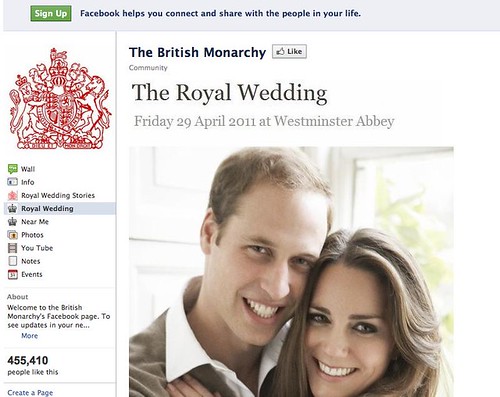
Finally I noted that Clarence House staff swiftly swept through the site to ensure that William and Kate's new titles are fully reflected in their biographies and even the URLs. (Yes, I have been reading it all)


As well as tweeting for the rest of us who had finally succumbed to romance, Fashion Critic was quick to post photos of the dresses and her thoughts on them.
There should also be plenty of hyperlocal street party action being posted over the next few days and if anyone out there wants to help gather them, I'd suggest the tag 'rw11hyperlocal'
While this was definitely a day when you want to be glued to a largescreen TV when you're not sipping Pimms in the street, having the web around enriched an historic day no end - with more pictures, wittier commentary, a host of extras and the voices of the crowds. Loved it.

My favourite picture of the day, via Popsugar & Getty
All pictures are screengrabs for illustration only, follow the links for originals and full source information.
All pictures are screengrabs for illustration only, follow the links for originals and full source information.
Friday, April 22, 2011
We are energy
This post is part observation of what communities (particularly, but not exclusively, digital communities) are doing, and part manifesto: me thinking that if we did even more of the things listed below we would overcome a lot of the city's challenges.
North Staffordshire is a complicated place of villages, towns and a city. Our area was one of the heartlands of the industrial revolution. Our ideas and products spread across the world and we retain easy links to the rest of Britain and further afield. We are surrounded by resources but for many people it can also be a very challenging place to live. For example, in Stoke-on-Trent many people live in substandard housing and experience poor health. Opportunities can be difficult to find and access. The city itself can be difficult to navigate. On the flipside, it's a low cost place to live and when the sun comes out and at least one of the football clubs is doing well, the spirit of the city is lifted.
North Staffordshire is a complicated place of villages, towns and a city. Our area was one of the heartlands of the industrial revolution. Our ideas and products spread across the world and we retain easy links to the rest of Britain and further afield. We are surrounded by resources but for many people it can also be a very challenging place to live. For example, in Stoke-on-Trent many people live in substandard housing and experience poor health. Opportunities can be difficult to find and access. The city itself can be difficult to navigate. On the flipside, it's a low cost place to live and when the sun comes out and at least one of the football clubs is doing well, the spirit of the city is lifted.
People coming together in groups help to keep communities healthy by raising wellbeing from simply spending time in each other's company, spending money together, making decisions collectively and exchanging information.
Together, we have more energy and more power.
These are some ways to access what's positive and do something about what's negative by building up people's skills, confidence and ability to:
+ find and navigate everything around us such as opportunities, events, spaces, resources
- challenge decisions, navigate and improve systems, overcome challenges and live more sustainably
+ find and navigate everything around us such as opportunities, events, spaces, resources
- challenge decisions, navigate and improve systems, overcome challenges and live more sustainably
- take part in opportunities to learn
- share our own knowledge and skills with others
- help to make links between people and organisations
- curate and collate information to make it accessible to more people
- share information about opportunities, spaces and services
- listen out for the positive and negative in the conversations around us and online.
As I said at the beginning of this post there are a lot of people already doing this. On Social Stoke I collect links to some of the good stuff that I've spotted.
Wednesday, February 23, 2011
A note for sharing
In my day, you were lucky if someone knew what you were talking about when you said "telephone". In the next few days, magical digital events are going to be coming faster than tweets during a student demonstration.
There are two major festivals, DATfest and Stoke Your Fires, with packed programmes involving pixels and bytes, about which more information is below.
If you'd like to share your super social media skills with people who've never had the opportunity, please come along to help at any point of the Social Media Cafes in Hanley library, details below on the DATfest website. You'll be very much thanked and rewarded with cake.
And on Wednesday 2nd, one of the ideas from the last Tweetup is going to be planned in more depth at a mini-tweetup meeting. Stoke Twestival is just over three weeks away and we've missed all the deadlines so nearly everything has yet to be organised. If you'd like to come and watch the world's fastest moving fundraising party take shape before your very eyes, leave a comment to this post with "Yes I'm free on Wednesday night" and I'll email you final details.
Over the next few days please can you do your bit as a digital citizen to talk about DATfest to all the people you know who aren't online. There are lots of great opportunities to get hands-on and learn all about technology in ways that aren't scary at all and the organisers have worked really hard to put together a pioneering digital programme right here in the Potteries, so please support it as much as you can.
THIS WEEKEND: Datfest: http://www.datfest.org.uk/
Stoke-on-Trent’s first ever digital arts and social media festival takes over venues and streets across the city centre for a weekend of events. Almost all of it will be free, with some events being ticketed and many drop-in.
The festival kicks off on Friday night with a multi-media electro-acoustic concert event at the Potteries Museum and Art Gallery performed by musicians from Keele University Music Technology Group.
On Saturday we take to the streets with B Arts’ 100 Stories – a unique walking tour around the city centre looking at Stoke’s hidden histories that blends live performance, projection and digital soundscapes.
On Sunday we end with a special bITjAM performance #mediafail. The digital discards we all have cluttering up our hard drives – out of focus photos, phone messages and video of the sky – will be transformed live into magical sounds and images.
As well as performance events there’s a full workshop programme that encourages all ages to join in and get creative. At the Central Library there’s social media surgeries for the over-fifties that will have you Flickering and Facebooking in no time; Lego animation workshops that will create brickfilms from your minifigure collection; and Mediafail workshops that provide a final resting place for your digital mistakes.
If you’ve got a suggestion for an event or would like to know more do get in touch at bitjam@me.com
Keep up with all the DATFEST news at www.datfest.org.uk
NOW TO MARCH 4th: Stoke your Fires http://www.stokeyourfires.co.uk/
Stoke Your Fires festival aims to be the creative heart of the West Midlands region for film and digital media in the eyes of artists, designers, producers and other industry professionals, critics, and of course the public.
Stoke Your Fires is a place to celebrate, innovate and stimulate exciting new work and creativity through these dynamic media but also provides a forum for the exchange of ideas, founding of new partnerships across commercial & public productions and a nurturing catalyst for career development.
The festival started in 2008, and has rapidly built an internationally recognised programme in animation and hopes to continue this across all genres of the moving image.
If you have any questions or would like to get involved please email info@stokeyourfires.co.uk
Saturday, January 01, 2011
Agile Stoke 2011
I wanted to revisit the predictions and hopes that Carl and I made last year, before 2011 got too far in. It was an exciting year, so busy that I feel like I've had very little time to write about it all, but there's something I'll try to change as a New Year's Resolution...
So with thanks to all the fab folk of the different communities on Twitter and elsewhere, and apologies for all the things I've missed, here goes:
Best was the tangible sense of a tipping point, as use of social media spread beyond the early adopters and started to become firmly embedded into many (not all yet) areas of Stoke life. There was the fantastic Teachmeet event at the new Sixth Form College, a really invigorating series of short presentations. Councillors and officers in the council are using Twitter with real confidence and we saw some firsts, like live tweeting from a council meeting and councillors tweeting each other inside them. Businesses and charities from what I think of as the mainstream establishment of Stoke life have adopted social media as well, which has a knock-on effect in raising the profile of the internet across the city and widening market access for the companies themselves. Jellifish and Boomerang PR are just two examples of local companies building up super success without having to plough millions into big city bases. A number of us enjoyed a trip down to Stafford with Talk About Local and had proper cross-county talks, leading to the establishment of local Race Online activities.
The maturing social media scene gave Stoke some great stories. Building on the platform of a mention in parliament right at the beginning of the year, Pitsnpots has grown up into a fully fledged Community Interest Company, Potteries Media CIC with the addition of 6 Towns Radio. Both of these are brilliant in their own right, but also vitally important for improving plurality in our local media. From the world of old media, the Sentinel is finding its digital feet, being able to amplify the stories that people are publishing through social media. If it could be bold enough to put more investment into combining old-fashioned journalism roles with this new wealth of local information feeds, it has a fantastic opportunity to build on its large and loyal readerships.
Four out of six of the towns now have their own well-established blogs. Just to pick on one, My Tunstall really shows what can happen when a man with the power to develop Drupal sites puts something together for residents with bees in their bonnet. Roads were adopted, huge amounts of money raised, stuff got cleaned and cleared up - it's the Big Society!. Tunstall has a lot of problems but is still one of my favourite towns and My Tunstall is a much-needed platform. I'd love to see every town and village in the city getting its own, which of course just depends on the people with the kind of passion these sites take being connected with the skills.
Last year we were dabbling in Ruby on Rails (which, like most of my pursuits in programming I didn't find the time to make much progress on) and this year's blog title picks up one of my current interests. Agile is a philosophy in programming that values (quote from Wikipedia):
- Individuals and interactions over processes and tools
- Working software over comprehensive documentation
- Customer collaboration over contract negotiation
- Responding to change over following a plan
I know, too many syllables. But squint your eyes a bit and substitute some key words and there's some good stuff in here.
2011 is going to be a difficult year for Stoke. We had a lot of plans - I'm one of the few people who makes a hobby of reading them (squinting my eyes and looking for the good stuff) - which now may or may not be abandoned altogether. Here, this doesn't just mean plans, it means land. From a low base Stoke has been hit hard by recession and cuts for a while but it's really biting now. Threat or opportunity looms, depending entirely on your perspective, knowledge and the various skills you might have had the fortune to pick up in your life. It will be a tough year for many people.
There's a lot we can learn from the culture of digital innovation, but more importantly this goes more with the grain of Stoke than many of the ideas that have been airdropped onto us in the last few decades. Generalising wildly as usual, we tend to value people and interactions over processes, things that work over endless documents and responding to change over following a plan.
“In sport, agility is often defined in terms of.. an integration of many components each used differently”. (Wikipedia)
To stretch the analogy a little further, if the Agile priority is working software, and Tom Berners-Lee's working code, then perhaps ours is a working city. You can interpret that as you want. For me, it's a city full of opportunity, flourishing in every aspect, freer from life-limited illnesses and early deaths. Every town, village and community valued as part of a diverse, sustainable city. Utopian, maybe, and certainly complex, but the web and our own history both show us that revolutions are possible in a very short time.
It's easy to get bogged down in Stoke's problems (yah, no kidding, says my weary reader), but I hope we becoming known for playing to our strengths, not arguing over our weaknesses.
We made pretty good progress in these things:
... the establishment of many social media cafes, where people can supplement in real life the connections they make online [here's the link - Mike has sketched out a monthly schedule for this in 2011 and the more volunteers involved the better]
... joining in the Global Twestival again [we did! This year?]
... joining in the Global Twestival again [we did! This year?]
... that we can build on the knowledge of a few to spread understanding and innovation in online literacy, web applications, programming and development through peer-to-peer learning [much to link to here].
... that we hold more unconferences in Stoke and support more national and local conversations, giving people space to explore ideas and collaborate. Particularly for Stoke itself, I hope we can have some more time and space to think about how information and the web can be used more effectively for delivering public services, community empowerment, engagement in politics, employment and economic development
... that we make greater use of what is on our doorstep. I've been thinking I should develop and promote Social Stoke more - it's building into quite a nice little resource [1,162 links and counting]
... that we make greater use of what is on our doorstep. I've been thinking I should develop and promote Social Stoke more - it's building into quite a nice little resource [1,162 links and counting]
Still on the to-do list:
... that some big digital players come to Stoke and experiment with our empty spaces, our talented people full of potential, our blossoming enthusiasm for digital technology and our natural understanding of creative industry and community. The Director of Digital Engagement & his [now her] office? Google? [Twitter?]
... maybe we'll finally find the use for Google Wave some of us dream of [?]
What new ones shall we add?
Hopefully a few of us will be getting our voices together on 6 Towns Radio so if you have any predictions or hopes, tweet them or leave them here...
Thursday, December 30, 2010
Maybe it's not Facebook's fault
Like many people, I have mixed feelings about Facebook. When I say mixed, I mean mostly negative. The only good things on Facebook are all the people I like(™) there. Because of them, I spend a lot of time there. I'm happy to accept too, that there's some good things about the way it automatically makes links of cats and photos of my boat easy to share. It helps me keep connected with people in ways that don't require too much thought or physical movement, which is great when you're (1) far away from many of the people you've made friends with in your life and (2) lazy. Little warms my heart as much than designing a virtual cupcake for a friend on her birthday, or steaming in with a little fertiliser for my mum's enormous Farmville ranch.
Beyond that, I harbour lots of resentment.The way they tinker with stuff for no good reason. How you have to go through no end of dilemmas about friend requests from people you can't remember, didn't like much or who you don't particularly feel comfortable knowing in *that* way. The privacy stuff-oh-my-god-yes: you have to watch your privacy settings like a hawk, because Zuckerburg has just flicked the switch that allows your neighbour's cat to tell the local burglar that you are out. I dislike its blue borders and the sense it's got me, whether I like it or not.
Unlike Twitter, I can't choose the method I use to speak to my friends beyond web or mobile (both of which look pretty much the same), and I can't stop using it because many of my friends don't use anything else online. It's like having a flatmate who gets on your nerves but nevertheless you have to see every f-ing day and who insists on showing you their sunny holiday photos despite your clear, silent, disinterest. And who, while they're at it, rearranges the furniture while you're out.
What annoys many most of all about Facebook is the sense that it is becoming a separate internet of its own. A private island, locked away from the open web, with more users in the UK than any other site except comparethemeercat.com.
But in a sudden seasonal turn, I thought – what if we're being unfair on Facebook? It's not Facebook that's closed off Facebook. It's us. We, the collective we, have decided that if Twitter and Linkedin are public, Facebook is private. In theory (although I've never seen it work in practice), Facebook has the same capability for RSS feeds as anything else. People who don't change their privacy settings can have all their stuff broadcast as easily as if they'd tweeted it. Equally, of course, private tweeting is just as acceptable. There are no rules except those we create ourselves.
I don't intend to change the way I use Facebook. It's the place where I go to say things that are way too dull to unleash on the open web. I like checking in on what old friends are having for tea, or who had a baby this week. Although I'm too paranoid to put much up that is genuinely private, it's still got photos of things that I don't want to share with everyone by default. But, having made that choice myself, it's not very fair to pin the blame on Facebook for holding closed data about me. The other choice would be to open it up completely. I could connect with everyone I've ever known for any length of time in a mission to create a complete, open social web of my life. But I don't really feel like doing that. If I do anything to reconcile my use of Facebook with the desire for a complete, open web, it'll just be to nudge some of my friends who are posting up Facebook content that really deserves a wider audience into blogging, or tweeting.
One of the things I have hazy memories of from history study was the concept of private and public spheres. This was a dividing line between men and women that, we learned, emerged in the Victorian era. Women spent most of the twentieth century trying to hop over the fence back into the public sphere. As a(n) historian, I now ask, how do we make these collective decisions? Looking back, will we find that Twitter = Public sphere & Facebook = Private sphere was a permanent decision, or will it shift once again?
Only time will tell. But in the meantime, I open up it up for the last few hours of your holiday entertainment – are we being unfair on Facebook? Discuss.
Friday, November 05, 2010
Coproducing our future
November's coprodnet conference in Manchester left my head full of stimulating ideas and renewed excitement about what can be done through collective action.
There was a lot to take in and digest. It was also clear that the word itself is open to wide debate and interpretation. I'll leave that to other people and just share one of the stories I learnt a lot from.
A story from Harare
"We realised that we cannot just sit and wait and hope... You are planning to build a house for me and it's not a house that I will like... the people who can get the paperwork will get the house and then they will just sell it"
Five years ago Zimbabwe embarked on a clearance programme. This was not clearance in the English sense, with bland notices, tense discussions, placards and compulsory purchase orders. This was just bulldozers with the label 'Drive out rubbish'.
"There are different circumstances in different countries, but being poor is being poor".
The story from Zimbabwe was one of hope and great achievement in circumstances that don't get much worse. We heard that the Zimbabwe Homeless People's Federation were doing some amazing things:
- built a membership of over 40,000 people
- supported neighbourhood savings and credit schemes
- negotiated for land and built houses
Their story is just one of many members around the world of Slum Dwellers International and they were able to get support from this and other NGOs and universities to make a difference.
How did they do it? How did they get so many people involved? The first step they described came as a surprise to me, but then I may not have been thinking about the real problem.
1. The group had to develop recognition. The urban poor weren't seen by anybody, their settlements were given different names by the authorities and they were told (forcibly) that if there wasn't work for them, they should return to the rural areas. Before they could do anything else, they had to organise in order to establish their right to exist.
2. They then gathered and recorded information to support their case for recognition. Things like how many people lived in their settlements, its history, the names they were using, what the community wanted and needed. This meant they had their own resources to take to the table: knowledge and information.
3. They built up local savings networks. 80% of their members are women and the clubs are based on very small networks. Once the banks collapsed, they stopped taking their money to them. Now they can save a little bit of money each day and make use of a revolving fund for crisis loans and income generation ideas. Most importantly, the tiny resources of the individual can be matched with the larger fund and in turn contributions from other organisations. As well as their savings, people can contribute sweat equity and their own skills to buildings.
4. With knowledge, money, information and the pooled resources of their community, teams identify land and begin negotiating with whoever owns it. They are now coing from a different position. They stopped saying yes to any offer ("bad land" far away from from the city centre) and made the point that the urban poor had a right to live close to the business district because they didn't have cars.
5. They draw on expertise and training as and when it is needed for legal services and building design. Sometimes they pay for this themselves, in other cases it is funded by the NGOs. This means the housing they build will be what they want.
6. A fundamental consideration is health. The networks share information, teach each other and "give each other the courage" to get tested for HIV.
The network is made up of small circles who save and learn, forming a community that in turn draws on the knowledge of other places around the world.
It was a joy to talk to Davious and Catherine from the Zimbabwean People's Federation. I'm sure there's a lot more to the story, many more hurdles and problems than we had time to talk about, but it was inspiring to hear their story and see their determination to build better homes for their communities.
Monday, October 04, 2010
Thursday, September 23, 2010
Mysteries of Sneyd Green
"AUCTION" it says in pink printer-ink on a poster taped to the door of the exceptionally well-priced off-license that lies within the snaky roads off Milton Road.
No more details except the time and location - which, apologies, I forgot to Twitpic - and "Vendor's arrive at 2pm".
An auction for what? Would the reckless bidder be raising his hand for fine art, cast-off Doulton figures or repossessed homes? Cars?
Meat strikes me as a distinct possibility.
In Burslem some years ago, the meat van was one of the Friday fixtures, with a man attached to a loudspeaker whipping the ladies up into a frenzy to buy his shrink-wrapped cuts covered in all manner of sauces. This was replaced later by a meat lottery at a local pub, apparently equally crowd-pulling.
I wonder but dare not ask. Does anyone know?
Tuesday, September 21, 2010
Web apps for healthcare
At the moment I'm trying to gather some communities stories about health and other aspects of wellbeing as part of a WEA Stoke community involvement project. Later in the year we hope to bring together some willing developers to help build these tools.
- A sort of Mapumental for choosing GPs, where GP data can be visualised on a map and information highlighted depending on what is important to the user, for example by satisfaction ratings, language, whether particular languages are spoken, how appointments can be booked etc.
- A text service where you send your postcode and the phone numbers of the nearest 5 GPs who are taking on patients are sent back.
- A map of hospitals showing waiting times, ideally in real time or by trend.
If anyone knows of these tools already being developed, knows data sources or would like to have a go, please speak up.
One more useful pointer for anyone developing content-rich website was this: the vast majority of people finding your website through a search are looking for the most basic information, such as opening times. So keep it simple.
Thursday, August 26, 2010
A social media strategy in brief
1. Get accounts where the people you want to reach are*
2. Start joining conversations. Always link back to a clear 'About' page
3. Share stuff.
* If your IT department blocks the sites you think will be useful, add these steps:
0.1 Get a laptop
0.2 Get a mobile broadband account
0.3 Proceed to step 1.
Subscribe to:
Posts (Atom)